AEO for Mobile Apps: How to Get Your App Cited in AI Search Answers
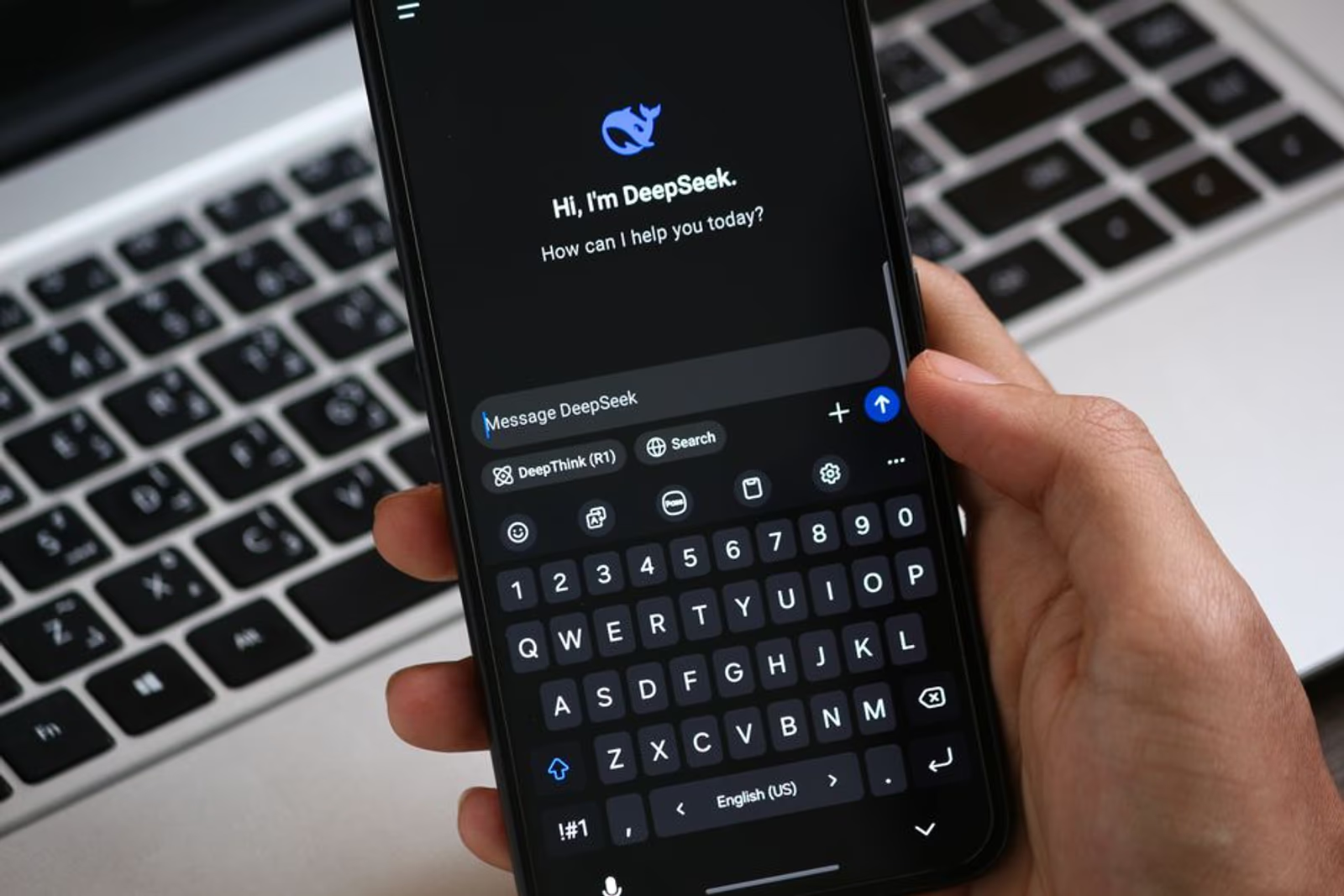
Most app marketers are still fighting over App Store rankings and Google search positions. Meanwhile, a growing share of users are asking ChatGPT, Perplexity, and Google AI Overviews which app they should download — and getting a direct recommendation without ever visiting a search results page.
If your app isn't in that recommendation, you don't exist in that channel. That's the whole problem answer engine optimization (AEO) solves for mobile app brands.
This guide is a practical implementation walkthrough. We'll cover how AI search engines decide what to cite, what signals your app's web presence needs to emit, and how to structure content so the models learn your app exists, what it does, and who it's for.
Why AI Search Treats Mobile Apps Differently
Web businesses have obvious AEO entry points: long-form content, landing pages, structured data. Mobile apps are trickier because a significant chunk of their "entity surface" lives inside two walled gardens — the App Store and Google Play — that AI crawlers typically can't read deeply or index authoritatively.
That gap creates both the problem and the opportunity. Your competitors are ignoring it. If you build a clear, machine-readable entity presence on the open web about your app, you're establishing authority in a space that's still largely unclaimed.
AI language models surface citations based on a few core signals:
- Entity clarity — Is it unambiguous what your app is, who it's for, and what problem it solves?
- Corroboration — Do multiple independent sources describe your app consistently?
- Structured data — Does your own website tell machines your app's name, category, platform, and rating in a format they can parse without guessing?
- Content depth — Is there substantive, specific content that answers the kinds of questions users ask AI about apps in your category?
None of these require a massive content operation. They require precision.
The Entity Foundation: What AI Needs to Know About Your App
Before you touch schema or write a single blog post, you need to define your app's entity profile — the canonical set of facts that should appear consistently everywhere your app is mentioned.
| Entity Attribute | Example | Where It Appears |
|---|---|---|
| App name (exact) | "MyPace" | Website, App Store, press mentions, schema |
| Category | AI fitness and nutrition app | Meta description, schema, third-party reviews |
| Primary platform(s) | iOS and Android | Schema, landing page, PR |
| Core use case | AI-driven fitness plans and habit tracking | H1, OG tags, App Store subtitle |
| Target audience | Adults building long-term fitness habits | Landing page copy, structured data description |
| Differentiator | Habit-building layer on top of workout tracking | Blog posts, comparison pages |
| Developer/brand | SEM Nexus | Organization schema, App Store developer profile |
Inconsistency kills citations. If your App Store listing calls it "an AI fitness tracker" and your website calls it "a wellness platform" and a review site calls it "a workout app," language models get confused about what the entity actually is. They'll skip a citation rather than risk getting it wrong.
Lock down your entity profile first. Then propagate it.
Schema Markup That Actually Moves the Needle
The two schema types that matter most for mobile app AEO are MobileApplication and SoftwareApplication. Both are recognized by Google and, through Google's indexed data, inform downstream AI systems.
A minimal but effective MobileApplication block looks like this:
{
  "@context": "https://schema.org",
  "@type": "MobileApplication",
  "name": "MyPace",
  "operatingSystem": "iOS, Android",
  "applicationCategory": "HealthApplication",
  "description": "AI-driven fitness, nutrition, and habit-building app for adults.",
  "offers": {
    "@type": "Offer",
    "price": "0",
    "priceCurrency": "USD"
  },
  "aggregateRating": {
    "@type": "AggregateRating",
    "ratingValue": "4.7",
    "reviewCount": "312"
  },
  "author": {
    "@type": "Organization",
    "name": "SEM Nexus",
    "url": "https://semnexus.com"
  }
}
Three common mistakes we see in audits:
- Missing
applicationCategory— Use the schema.org enumeration values. "HealthApplication," "SportsApplication," "BusinessApplication." Generic descriptions don't machine-parse cleanly. - Stale
aggregateRating— If your schema says 4.8 stars from 50 reviews and your live App Store listing shows 4.1 from 800, you've created a credibility gap that erodes trust signals. - No
authororpublisherlinking back to your Organization schema — This is how you connect app entity → developer entity → website entity into a coherent knowledge graph.
Beyond MobileApplication, make sure your main domain has a fully populated Organization schema that explicitly references your app — use the makesOffer or owns property to link them. This matters because AI models often answer questions about companies, not just products.
Content Architecture for AI Citations
Schema tells machines what your app is. Content tells them when to recommend it. These are two different jobs, and most app landing pages only do the first one.
AI search engines pull citations when a user query maps to a question your content demonstrably answers. For mobile apps, the high-value query patterns look like:
- "What's the best app for [use case]?"
- "Is there an app that does [specific function]?"
- "What app do [target audience] use for [problem]?"
Your content strategy should create pages that directly answer these patterns — not blog posts titled "Top 10 Fitness Apps" (you'll never outrank established publishers for that), but pages where your app is the authoritative subject.
Comparison pages work exceptionally well. A page titled "MyPace vs. MyFitnessPal: What's Different About the Habit Layer" does three things: it establishes your app as a known entity in the category, it answers a real user question, and it gives AI search a clean, citable source when someone asks about the difference.
Use case pages are underutilized. If your app targets runners, create a page specifically about how the app works for runners. Specificity beats generality in AI citation retrieval. Perplexity is more likely to recommend your app in response to "best app for marathon training" if you have a page that speaks directly to marathon training than if you only have a generic fitness app landing page.
FAQ sections with exact-match questions pull disproportionate weight. The FAQ section on this very post is an AEO tactic — AI models lean heavily on Q&A formatted content because it mirrors how users phrase queries.
For a broader look at how search visibility layers connect, see our post on 6 SEO tips for boosting local business visibility — the entity and citation principles overlap significantly with what we're describing here.
Want an AEO audit for your app? Our team maps your current entity footprint across ChatGPT, Perplexity, and Google AI Overviews — and builds the structured content plan to close the gaps. See our AEO services →
Off-Site Signals: Corroboration and Third-Party Citations
AI models are probabilistic. They cite sources that appear consistently across the web, not just the source that tries hardest. That means your AEO strategy has to extend beyond your own website.
The highest-value off-site corroboration sources for mobile apps:
- App review sites (AppAdvice, AppGrooves, AlternativeTo) — These are crawlable, trusted, and consistently cited by AI models. Claim and optimize your listings. Make sure the app description on each matches your canonical entity profile.
- Press coverage — Even one solid TechCrunch or Product Hunt post creates a corroborating data point that reinforces your entity in multiple training and retrieval indexes.
- Developer and founder profiles — If your founder has a consistent presence (LinkedIn, a personal site, Twitter/X) that references the app, it adds an additional corroborating entity connection.
- Third-party reviews on G2, Capterra, or Trustpilot (for B2B apps) — These platforms are explicitly indexed and cited frequently in AI answers about software tools.
The pattern to aim for: when an AI model encounters a query about your app category, it should find your app name, consistent description, and positive signal across at least four or five independent sources. That's when citations start appearing reliably.
For a deeper look at how citation-building connects to broader digital authority, the principles in AEO Agency Pricing Guide: What Does Answer Engine Optimization Cost in 2026? are worth reading alongside this one.
Measuring AEO Performance for Apps
Unlike traditional SEO, you won't find a single dashboard that shows your AI citation rate. You need to build a lightweight monitoring setup.
In our engagements, we track the following on a weekly basis:
| Signal | How to Track |
|---|---|
| Direct ChatGPT citation | Manual query testing across 10–15 target questions |
| Perplexity appearance | Same query set, Perplexity Pro for source inspection |
| Google AI Overviews | Search Console + manual spot checks on branded queries |
| Branded search volume | Google Search Console, keyword trend |
| Third-party mention count | Ahrefs/Semrush brand mention tracking |
The leading indicator that your AEO work is compounding is an increase in branded direct queries alongside new citation appearances. Users who encounter your app in an AI answer then search for it by name. That loop is the long-term payoff.
Expect a lag of approximately 60–90 days between structural changes (new schema, new content) and measurable citation appearances. AI systems don't update in real time.
FAQ
What is answer engine optimization for mobile apps?
Answer engine optimization (AEO) for mobile apps is the practice of structuring your app's web presence — schema markup, landing pages, FAQ content, and third-party mentions — so that AI systems like ChatGPT, Perplexity, and Google AI Overviews recommend your app by name when users ask relevant questions.
Does App Store optimization (ASO) overlap with AEO?
They're complementary but distinct. ASO targets visibility within App Store and Google Play search. AEO targets visibility in AI-powered answer engines on the open web. App Store content is largely inaccessible to AI crawlers, so your AEO work happens primarily on your website and across third-party indexed sources.
What schema type should I use for my mobile app?
Use MobileApplication (a subtype of SoftwareApplication) for the app itself. Connect it to your Organization schema on your main domain. Include operatingSystem, applicationCategory, aggregateRating, and author at minimum.
How long does it take to get cited in AI search answers?
Typically 60–90 days from implementing structural changes, assuming your content and schema are solid and you have at least several corroborating off-site mentions. Highly competitive categories take longer. New apps with no existing entity footprint should expect the longer end of that range.
Do I need a blog to rank in AI search for my app?
Not necessarily, but targeted content — comparison pages, use case pages, FAQ pages — dramatically increases citation frequency. Static landing pages alone rarely generate citations beyond branded queries. Even three or four high-specificity pages can move the needle meaningfully.
My app is in a competitive category. Is AEO still worth pursuing?
Yes, and arguably more so. In our engagements, competitive categories are where AEO provides the clearest asymmetric advantage — most competitors are focused entirely on paid UA and ASO, leaving the AI citation layer uncontested. An app with strong entity clarity and corroboration will consistently outperform louder competitors in AI answers.
If your app isn't showing up when users ask AI which app to download, that's a positioning gap, not a discovery problem. The fix is concrete: define your entity profile, implement the right schema, build a small set of targeted content pages, and get your app mentioned consistently across indexed third-party sources.
Semnexus handles the full stack — AEO services, structured data implementation, content architecture, and ongoing citation monitoring. If you want to map where your app stands today and what it would take to get cited in ChatGPT, Perplexity, and Google AI Overviews, book a 30-minute call and we'll walk through it together.