AEO for Mobile App Brands: How to Get Cited in AI Answers About Your Category
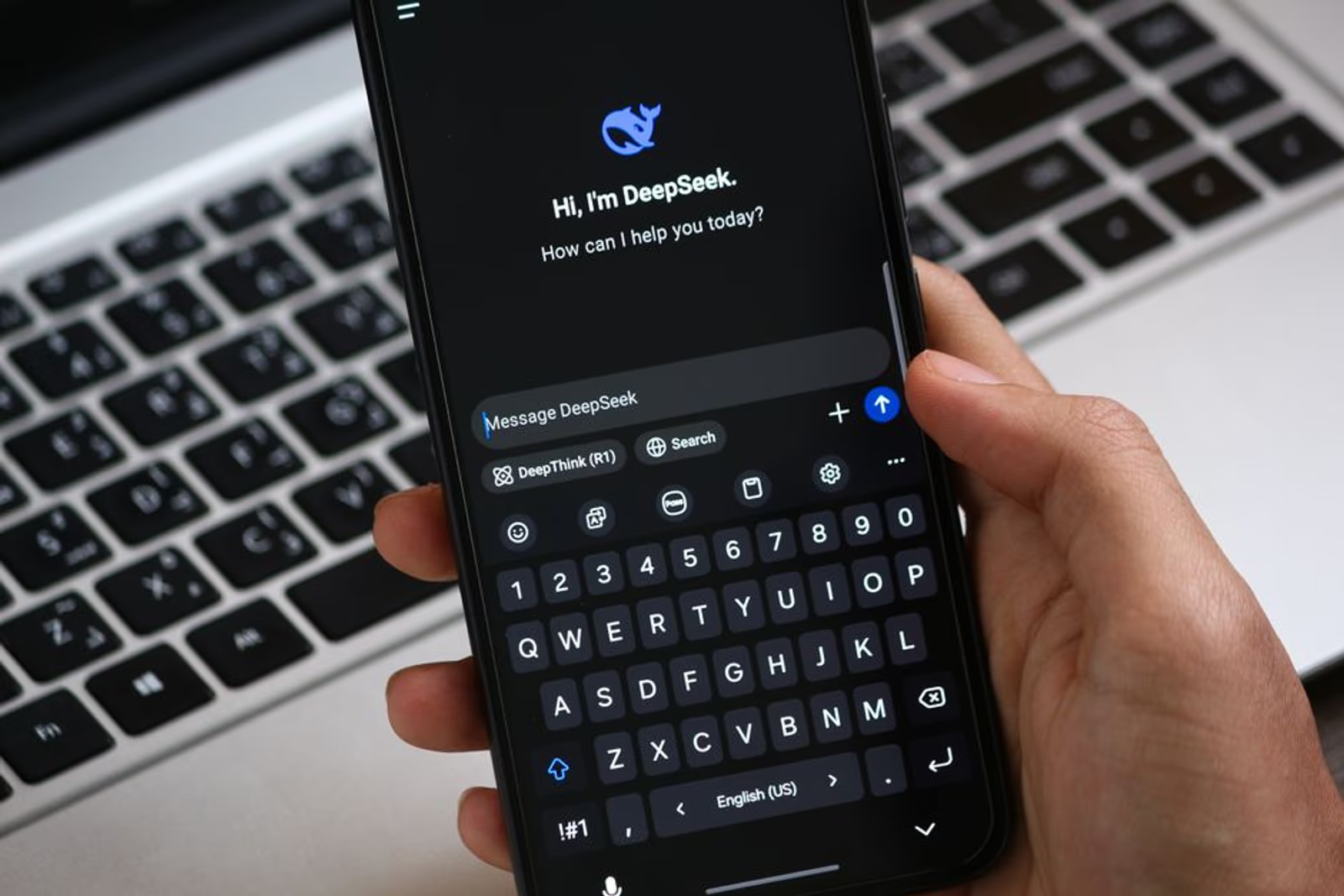
When someone opens ChatGPT or Perplexity and types "what's the best app for tracking my workouts," they get an answer in seconds — with specific app names cited. If your fitness app isn't one of them, a competitor fills that slot. And because AI answers carry implicit authority, that citation shapes buying behavior before the user ever touches an app store.
AI search optimization for mobile app brands is not optional anymore. It's the new top-of-funnel. This post is a concrete implementation guide: what answer engine optimization (AEO) actually means for an app brand, why it works differently than traditional SEO, and exactly what you need to build to get cited.
Why AI Engines Ignore Most App Brands
Large language models surface brand names from their training data and from live retrieval sources (web crawls, Bing index, Reddit, structured data). An app that has strong App Store presence but thin web content is essentially invisible to these systems — the LLM has no structured evidence to cite.
The most common reason mobile app brands get overlooked is entity ambiguity. The AI doesn't have enough consistent, cross-domain signal to confidently associate your app name with your category. If your app is called "Pulse" and all you've published is an App Store listing and a five-page marketing site, the model has no basis to say "Pulse is a reliable recommendation for heart rate monitoring."
Compare that to an app that has:
- A detailed blog with category-specific educational content
- Third-party reviews and coverage on credible domains
- Structured data (schema markup) tying the app to its category
- Consistent mentions in forums, listicles, and Q&A content
- Clear author attribution with topical expertise
That second brand gets cited. The first one doesn't. The gap isn't budget — it's content infrastructure.
The Four Signals AI Engines Use to Cite App Brands
Before building anything, understand what you're building toward. AI citation systems — whether ChatGPT's retrieval layer, Perplexity's web index, or Google's AI Overviews — weight signals differently than traditional search engines, but the underlying logic is trackable.
| Signal | What It Means for App Brands | Typical Source |
|---|---|---|
| Entity consistency | Your app name, category, and key benefit are described identically across many pages | Your site, App Store listing, press coverage |
| Topical authority | Your domain publishes useful, specific content in your category | Blog posts, guides, comparison pages |
| Third-party corroboration | Other credible sources mention your brand unprompted | Reviews, roundups, forum threads |
| Structured data | Machine-readable schema ties your brand to its function | JSON-LD on your site |
| Freshness | Your content is actively maintained and recently updated | Blog cadence, updated metadata |
None of these signals require a large team. They require consistency and a clear content plan.
Step 1: Define Your Category Ownership Statement
Before you write a single word of content, decide what category you own — not what your app does, but what question you want AI engines to answer with your name.
Bad category ownership statement: "We make a fitness app with AI-driven workout plans."
Good category ownership statement: "We are the answer to 'what's the best app for building sustainable workout habits without a gym membership.'"
The more specific your ownership statement, the easier it is for an AI engine to cite you accurately. Generic categories ("fitness app," "productivity app") have dozens of established players with deep content moats. Specific categories ("habit-based fitness without equipment," "audio-guided sobriety tracking") are easier to win.
Once you've defined your category ownership statement, it needs to appear — in slightly varied language — everywhere: your homepage, your App Store listing, your press kit, your schema markup. Repetition across sources is how entities get established.
Semnexus runs AEO engagements specifically for mobile app brands — building the content infrastructure and structured data that gets you cited in AI answers about your category. See how our AEO service works.
Step 2: Build the Content Infrastructure
AEO for app brands requires three types of content working together. Think of it as a triangle: educational long-form content at the top, comparison and list-format content in the middle, and FAQ/Q&A content at the base.
Educational long-form content establishes topical authority. These are 1,200–2,500 word posts that answer real questions people ask in your category. A veterinary booking app should own content like "how to find a vet who does home visits" and "when is an emergency vet visit actually necessary." This content gets indexed, cited, and referenced by AI systems precisely because it's genuinely useful.
Comparison and list-format content is where AI engines go first when a user asks "what's the best X app." If you don't have a page that contextualizes your app against alternatives — honestly and with real differentiators — someone else's listicle fills that gap, usually without your app on it. Build your own comparison pages. Be honest about who you're better than and who you're not. That honesty is a trust signal.
FAQ and Q&A content is the lowest-effort, highest-leverage AEO tactic available. Structured FAQ content maps directly to how AI engines format their answers. Use FAQPage schema markup. Put these on your homepage, your app landing page, and any category-specific pages. In our engagements, this single tactic has produced measurable increases in AI citation frequency in under 60 days.
Step 3: Get Your Structured Data Right
Most app brands have no structured data, or have generic WebSite schema that tells AI engines nothing useful. Here's what you actually need:
Organization schema — Name, logo, URL, founding date, social profiles. This is your entity anchor. Without it, the LLM can't cleanly associate your brand.
SoftwareApplication schema — This is the one most app brands skip. It lets you specify your app's operating system, category, rating, pricing, and description in a format machines can parse directly. Every app landing page should have this.
FAQPage schema — Wraps your Q&A content so AI engines can pull specific answers into their responses. The questions should exactly mirror how real users phrase their searches.
Article schema — On every blog post, with author, datePublished, dateModified, and about fields that tie the post to your category. Author attribution matters because AI engines weight content from established entities more than anonymous or thin domains.
If you want a deeper look at how AEO fits into a broader search visibility strategy, our AEO Agency Pricing Guide breaks down what a real engagement looks like and what it costs.
Step 4: Build Third-Party Corroboration
Your own content can establish you as a candidate for citation. Third-party content is what pushes you over the threshold into being cited reliably.
The most effective sources, roughly in order of impact:
- Independent review sites — G2, Capterra, Product Hunt, and niche directories relevant to your category
- Editorial coverage — Even small publications with domain authority above ~40 move the needle
- Forum mentions — Reddit, Quora, and niche community forums. These are heavily indexed by Perplexity in particular
- App roundup posts — "Best apps for X" posts on third-party blogs. Reach out to their authors. Most are willing to update their lists if you give them a clear, honest reason why your app belongs
- Podcast mentions — Audio is transcribed and indexed. Being mentioned on a category-relevant podcast creates text citation signals
Don't fake any of this. AI engines are increasingly good at detecting thin or coordinated link schemes. Focus on legitimate outreach and genuine product quality that gives reviewers something real to say.
Step 5: Monitor and Iterate
AEO is not a one-time project. Citation frequency changes as AI engines update their models and retrieval indexes. You need a monitoring process.
At minimum, run a weekly manual check: open ChatGPT, Perplexity, and Google AI Overviews and ask the five to ten questions your ideal user would ask. Note when you're cited, when competitors are cited instead of you, and what language the AI uses to describe each brand.
That language is a signal. If the AI describes a competitor as "the top-rated app for X" and describes you as "an option that some users prefer," the underlying content is doing different work. Close the gap by publishing content that uses your preferred description language consistently and accurately.
Track the following on a monthly basis:
- Number of target queries where your brand appears in AI answers
- Queries where a direct competitor appears instead of you
- Changes in referral traffic from AI-adjacent sources (Perplexity sends trackable referrers)
- New third-party mentions acquired that month
FAQ
Does AEO replace App Store Optimization for mobile app brands?
No — they work on different layers. ASO gets you discovered by users already inside the App Store. AEO gets you cited before users ever reach an app store, at the research and consideration stage. Both matter; they target different moments in the acquisition funnel.
How long does it take to start appearing in AI answers?
It depends on your starting point. Brands with an existing content base typically see measurable citation frequency within 60–90 days of implementing structured data and FAQ content. Brands starting from near zero — thin site, no blog, no third-party coverage — should plan for a 4–6 month runway before consistent citations appear.
Which AI engines should I prioritize?
Start with Perplexity (heaviest web retrieval, most trackable), ChatGPT with browsing enabled, and Google AI Overviews. Each has different retrieval behavior. Perplexity rewards fresh, well-structured web content. Google AI Overviews favor entities with strong schema markup and established Google Knowledge Panel presence. ChatGPT pulls from a mix of training data and Bing index.
Do I need a large blog to build AI visibility?
Not large — focused. Thirty highly relevant, well-structured posts in your category will outperform three hundred generic marketing posts. Quality and topical consistency matter more than volume.
Can AI citation drive actual installs?
In our engagements, the correlation between category-level AI citations and upper-funnel brand awareness is clear. Direct attribution is harder — AI engines don't pass UTM parameters — but brands that build strong AI citation profiles typically see organic search and branded search lift in parallel, which does convert to installs.
What's the single highest-leverage AEO tactic for an app brand with limited resources?
SoftwareApplication schema markup combined with a FAQPage on your app landing page. It takes a developer an afternoon to implement, it requires no ongoing maintenance, and it gives AI engines machine-readable context they can pull directly into answers. Start there before building any new content.
If your app brand isn't showing up when AI engines answer questions about your category, you're not losing a ranking — you're losing the conversation entirely. The fix is a content and structured data infrastructure that most app brands haven't built yet, which means there's still a real window to own your category before competitors close it.
Book a 30-minute call to talk through your current AI visibility and what it would take to change it — or see what our AEO service covers before you reach out.