AI Automation for App User Segmentation: What to Automate and What Not To
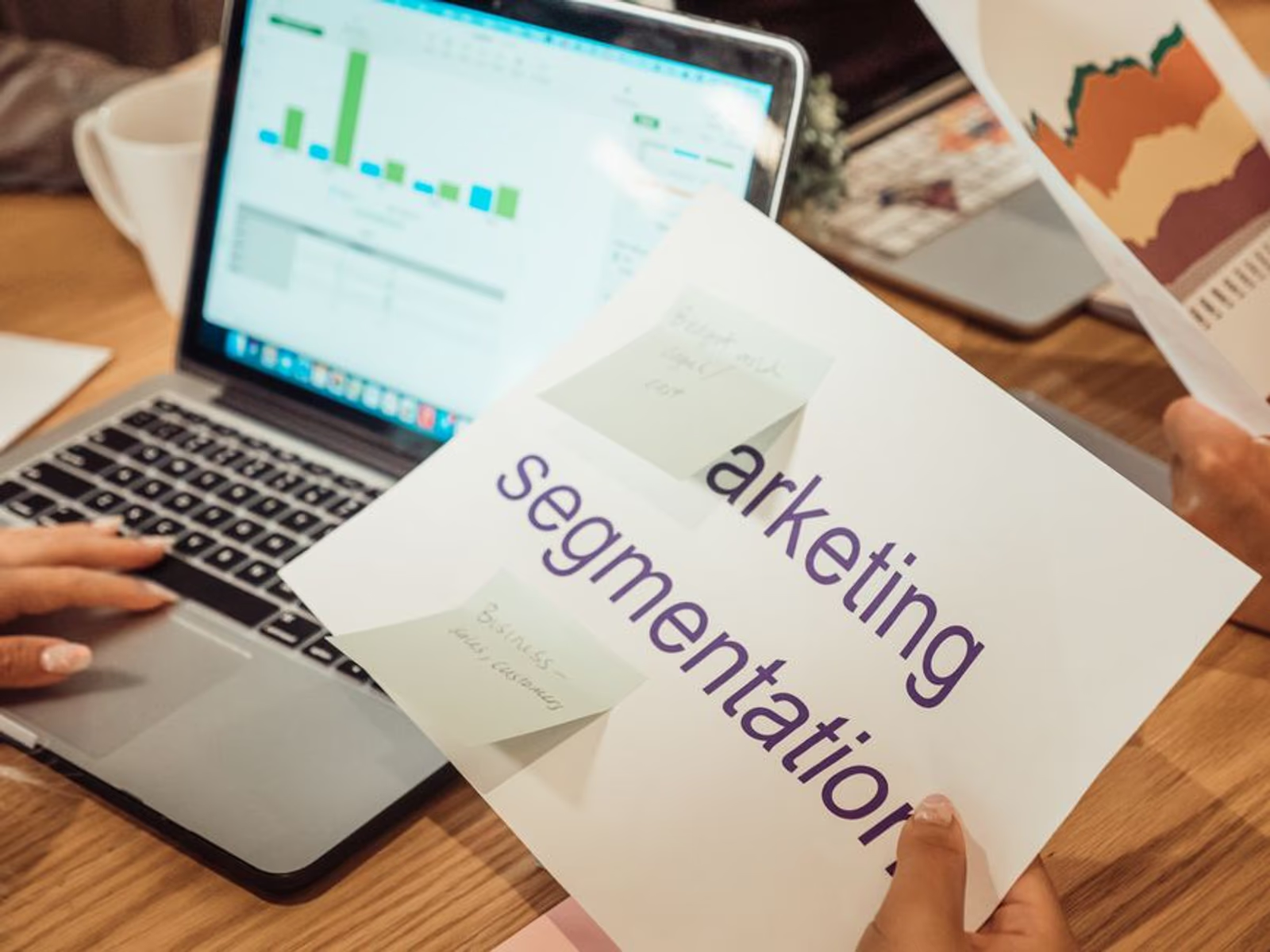
Most app teams fall into one of two camps when they first touch AI business automation for user segmentation. Camp one automates everything — they pipe raw events into a clustering model, let it generate segments, and push those segments straight into their CRM and messaging tools without a second look. Camp two gets spooked by the black-box nature of ML models and keeps every segmentation decision inside spreadsheets reviewed by a single analyst who is already drowning.
Both approaches are wrong, and both are expensive in different ways.
This guide maps out exactly which segmentation tasks benefit from automation, which ones need a human in the loop, and which ones look automatable but will quietly destroy your retention metrics if you let a model own them unsupervised.
Why Segmentation Is a Good Candidate for AI Automation — Up to a Point
User segmentation is data-dense, repetitive, and time-sensitive. Those three properties together make it a natural fit for AI business automation. A model can ingest millions of behavioral events, find clusters a human analyst would miss, and refresh those clusters daily without burning analyst hours.
The catch: segmentation outputs feed downstream decisions — push notification copy, paywall timing, onboarding variant selection, churn intervention triggers. A bad segment definition doesn't just waste one message; it poisons every decision that depends on it for weeks. That's a higher-stakes failure surface than most teams acknowledge before they automate.
So the framing isn't "should we automate segmentation?" It's "which layers of segmentation are safe to automate, and which layers need human validation gates?"
The Four Layers of User Segmentation
Think of segmentation as a stack, not a single task:
- Data collection and event taxonomy — what gets tracked and how it's labeled
- Segment definition — the rules or model outputs that assign users to groups
- Segment activation — pushing segment membership into downstream tools
- Segment evaluation — measuring whether segments are predictive and stable over time
AI automation can handle layers 2, 3, and parts of 4 well. Layer 1 and the interpretive parts of layer 4 need humans.
What to Automate
Behavioral Clustering and Pattern Detection
Raw behavioral clustering — grouping users by session frequency, feature engagement depth, event sequences — is exactly what unsupervised ML models are built for. A k-means or DBSCAN run on normalized event data will surface cohorts in minutes that would take an analyst days to find manually.
Automate this. The model doesn't get tired, doesn't anchor on last week's intuition, and will find the seven-session-streak power user cohort you didn't know existed.
Also automate:
- RFM scoring (recency, frequency, monetization) updated on a rolling basis
- Churn propensity scores driven by behavioral signals like session length decay, feature abandonment, or notification opt-out
- Lifecycle stage transitions — moving a user from "new" to "activated" when they hit a defined event threshold
- Lookalike audience exports — automating the refresh of high-LTV lookalike lists for paid acquisition
In our engagements with marketplace and fitness apps, automated RFM refresh alone typically eliminates 6–10 hours of weekly analyst work with no meaningful drop in segment quality — and usually improves freshness because the model runs nightly instead of weekly.
Segment Activation and Sync
Once segments exist, syncing them to Braze, Amplitude, Iterable, or your CRM of choice is pure plumbing. Automate it. There's no judgment call here — if a user's churn propensity score crosses a threshold, they should be in the win-back segment within hours, not waiting for someone to export a CSV on Friday afternoon.
Automation tools — whether custom-built or via a workflow layer like n8n or a vendor connector — handle this reliably at scale.
Anomaly Flagging
AI models can monitor segment membership changes and surface anomalies: a segment that doubled in size overnight, a churn cohort that's trending younger than usual, an activation rate that dropped below a historical baseline. Automate the detection; don't automate the response.
The model's job is to raise its hand. A human's job is to decide whether the anomaly is a product bug, a campaign effect, or a genuine behavioral shift worth acting on.
What Not to Automate
Segment Naming and Business Interpretation
This one sounds trivial. It isn't. A model will produce Cluster 4 with characteristics it can describe statistically. It cannot tell you whether Cluster 4 is your "price-sensitive seasonal user" or your "confused onboarding dropout" — two groups that look similar in event data but require completely different messaging strategies.
A human has to name and interpret every segment before it goes into production. That interpretation step is where product intuition, qualitative research, and business context live. Skip it and you'll run "re-engagement" campaigns at users who actually churned because of a bug in the checkout flow, not because they lost interest.
Segment Strategy Decisions
Which segments get a paywall? Which get a free trial extension? Which get a human success manager outreach versus an automated drip? These are strategic decisions with revenue implications. They require someone who understands the business model, the competitive context, and the current quarter's priorities.
AI can surface that a segment exists and that it's sizable. It can't tell you whether acquiring more users who look like that segment is worth the CAC, or whether the segment's behavior pattern reflects a product gap you should fix instead of messaging around.
Merging or Splitting Segments
Models will propose merges and splits as your user base evolves. Sometimes that's right — two clusters that converged because of a product change should probably be combined. Sometimes it's wrong — the model is conflating users who look similar in event data but have fundamentally different intent signals that don't show up in the behavioral log.
Every merge or split decision should be reviewed before it propagates downstream. The blast radius of a bad merge is large: every campaign, every A/B test, every cohort analysis that references those segments becomes unreliable.
The Automation Decision Matrix
| Segmentation Task | Automate? | Notes |
|---|---|---|
| Behavioral clustering (initial) | Yes | Run model, review outputs before naming |
| RFM score refresh | Yes | Nightly or weekly, fully automated |
| Churn propensity scoring | Yes | Threshold alerts still need human review |
| Lifecycle stage transitions | Yes | Requires clean event taxonomy upfront |
| Segment sync to CRM / messaging tool | Yes | Pure plumbing, no judgment needed |
| Anomaly detection | Yes | Detection automated; response is not |
| Segment naming and interpretation | No | Always human |
| Segment strategy (paywall, trial, etc.) | No | Business-level decision |
| Merging or splitting segments | No | Human review before propagation |
| Event taxonomy design | No | Garbage in, garbage out — requires product + data alignment |
| Qualitative validation (user interviews) | No | Models can suggest; humans confirm |
The Failure Mode to Avoid: Full-Autopilot Segmentation
The worst pattern we see is teams that automate the full loop — model generates segments, segments activate in the messaging tool, campaigns fire — with no human checkpoint between model output and customer-facing message.
This creates what we'd call a silent compounding error: the model's segment definitions drift slowly over time as user behavior shifts, the downstream campaigns keep firing based on stale or incorrect groupings, and no one notices until retention metrics have been quietly declining for two months. By then, the damage is already done and the cause is hard to trace.
For more on how AI systems fail silently in production, see our breakdown of agent failure modes — many of the same dynamics apply to automated segmentation pipelines.
Running app marketing campaigns without validated segments is expensive. Our mobile app marketing team can audit your current segmentation setup and identify where automation is helping — and where it's quietly hurting.
Building a Sustainable Human-in-the-Loop Workflow
The goal isn't to minimize human involvement. It's to concentrate human judgment where it actually matters and automate everything else.
A practical workflow looks like this:
- Model runs nightly — refreshes RFM scores, churn propensity, lifecycle transitions, behavioral clusters
- Anomaly report lands in Slack — anything outside a defined threshold triggers a review request, not an automatic action
- Weekly segment review (30–45 minutes) — a product or growth person reviews new cluster outputs, names any new segments, approves merges or splits, and flags anything that needs qualitative follow-up
- Quarterly strategy review — which segments are driving value, which segments should be deprecated, what the model is missing that qualitative research would catch
This structure keeps automation doing the high-volume, repetitive work while ensuring a human is upstream of every decision that touches customers.
Building this kind of workflow well requires clean event instrumentation from the start. If your event taxonomy is inconsistent — different names for the same action across platforms, missing timestamps, untracked edge cases — the model will produce garbage regardless of how sophisticated it is. That's a product and engineering problem before it's an AI problem. We've covered this in detail in our look at AI agent cost modeling, where data pipeline quality shows up as one of the biggest hidden cost drivers.
FAQ
Can AI segmentation replace a dedicated data analyst?
No, and framing it that way leads to the silent compounding error described above. AI handles the mechanical work of clustering and scoring. A data analyst handles interpretation, strategy, and qualitative validation — none of which a model does reliably.
What's the minimum data volume where AI segmentation starts to make sense?
Approximately 10,000 monthly active users with consistent behavioral event tracking is a reasonable floor. Below that, the clusters tend to be statistically unstable and you're often better served by simple rule-based segmentation.
Which tools handle automated segmentation well?
Amplitude, Mixpanel, and Braze all have built-in segmentation and scoring features. For custom scoring models, Python-based pipelines (scikit-learn for clustering, XGBoost for churn prediction) feeding into your CRM via API is a common pattern in our engagements.
How often should automated segments be refreshed?
RFM and churn scores should refresh at least weekly — daily is better if you're running time-sensitive campaigns. Behavioral cluster definitions (the underlying model) should be re-trained monthly or after any significant product change.
What's the biggest mistake teams make when automating segmentation?
Automating the activation step before they've validated the segment definitions. A model can confidently produce a churn risk segment that's actually capturing users who are power users on a feature your event tracking doesn't log correctly. Validate first, activate second.
Does this apply to B2B apps the same way it applies to B2C?
The same principles apply, but B2B apps typically have smaller user populations with higher per-user revenue stakes — which actually raises the bar for human review, not lowers it. A miscategorized enterprise account is a much bigger problem than a miscategorized consumer user.
If you're building out your segmentation stack and want a clear view of what's worth automating versus what needs a stronger human layer, book a 30-minute call or reach out to our mobile app marketing team to walk through your current setup.