How to Diagnose a Broken App Acquisition Funnel in One Afternoon
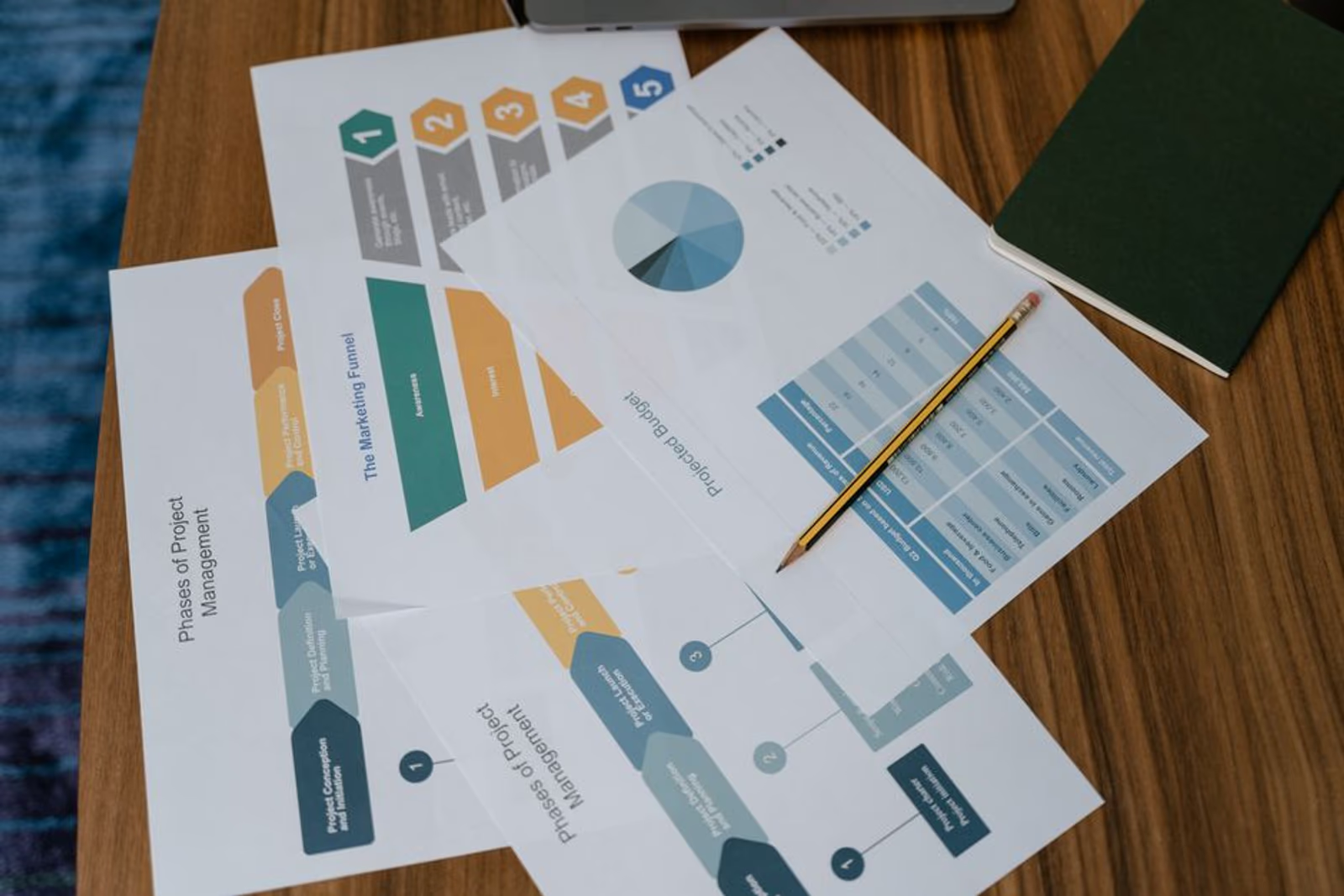
Most app teams already have the data to find their funnel problem. They just don't know what to look at first, or they're looking at the wrong metric and drawing the wrong conclusion.
This is a four-hour framework. No new tools required. By the end, you'll know which stage of your app acquisition funnel is the primary leak — and you'll have enough signal to write a concrete fix brief for your team.
Start With a Funnel Map, Not a Dashboard
Before you open any analytics tool, draw the funnel on paper or a whiteboard. Every app's acquisition funnel has the same five stages, even if the specific mechanics differ:
- Impression — Someone sees an ad, a search result, an App Store listing, or a social post.
- Click / Tap — They engage with that impression and land somewhere (App Store page, landing page, deeplink).
- Install — They download the app.
- Registration / Onboarding — They create an account or complete a core setup step.
- Activation — They complete the action that correlates with long-term retention (the "aha" moment).
Write each stage on a sticky note. Then, before you pull any numbers, hypothesize where you think the break is. This step sounds trivial. It isn't. It forces you to commit to a guess, which makes the data more readable when you see it.
Gather the Right Numbers for Each Stage
You need one conversion rate per stage. Here's where to pull each one:
| Funnel Stage | Where to Pull It | Metric Name |
|---|---|---|
| Impression → Click | Ad platform (Meta, Google UAC, Apple Search Ads) | CTR |
| Click → Install | MMP dashboard (AppsFlyer, Adjust, Branch) or platform-native | Click-to-Install rate |
| Install → Registration | App analytics (Mixpanel, Amplitude, Firebase) | Onboarding completion rate |
| Registration → Activation | App analytics — custom event | Activation rate |
| Paid channel → Organic lift | ASO dashboard (AppFollow, AppTweak) | Branded search uplift |
If you don't have an MMP connected, the click-to-install number will be approximate at best. You can use App Store Connect or Google Play Console install reports against your ad platform click counts as a rough proxy, but it will be inflated because organic installs mix in. Flag that limitation as you go — it matters for the diagnosis.
Pull 30 days of data minimum, 90 days if you have it. Single-week snapshots can be misleading due to creative rotation, seasonal shifts, or a single viral spike.
Identify the Primary Leak
Once you have the five conversion rates, you're looking for the stage with the steepest relative drop — not the lowest absolute number, the biggest step-change between stages.
A common pattern in our engagements: an app shows decent CTR on paid ads, a reasonable install rate, and then a catastrophic drop between install and registration. That's typically an onboarding problem, not an acquisition problem. Spending more on ads with a broken onboarding flow is burning money.
Another common pattern: strong CTR, but the click-to-install rate is very low. That usually means the App Store page isn't delivering on what the ad promised. Users land, look at the screenshots, read the description, and leave. The fix is ASO work, not creative optimization.
A third pattern — one that gets missed often — is strong installs but weak activation. The app is getting downloads, onboarding feels smooth, but users never complete the first meaningful action. That's a product problem wearing a marketing costume.
Rank your stages from worst to best conversion rate relative to category benchmarks. Industry-wide benchmarks vary by vertical and channel, but approximately:
- Install-to-registration rates below 40% are a red flag for consumer apps
- Activation rates below 25% of registered users typically indicate an unclear value proposition in onboarding
- CTRs below 1% on Meta app install campaigns suggest creative fatigue or mismatched audience targeting
These are rough guides, not hard rules. The more important signal is the shape of your specific funnel relative to your own historical baseline.
Audit the Stage That's Leaking
Once you've identified the primary leak, you run a targeted audit — not a full-funnel teardown. Here's what to examine at each stage:
If the leak is Impression → Click:
- Are you targeting the right audience segments? Check audience overlap and saturation.
- Has your creative been in rotation for more than three weeks? Creative fatigue sets in fast on Meta and TikTok.
- Is the value proposition in the ad copy specific enough? "The best fitness app" doesn't convert. "Build a workout in 60 seconds" does.
If the leak is Click → Install:
- Does your App Store page match the ad? The visual language, the promise, the audience — if these are misaligned, users bounce immediately.
- Are your screenshots actually showing the product in use, or are they lifestyle images with text overlays?
- What do your first three reviews say? A 3.2-star average will kill install conversion no matter how good the ad is.
For a deeper look at what drives installs from the store page itself, the principles in 2026 Mobile User Acquisition Strategy cover how to think about the paid-to-organic handoff in more detail.
If the leak is Install → Registration:
- Map every screen between app open and the first authenticated state. Count the taps required.
- Are you asking for permissions (notifications, location, contacts) before the user has seen any value? Move those requests post-activation.
- Is there a social login option? Friction at registration is one of the most addressable problems in the funnel.
If the leak is Registration → Activation:
- Define activation precisely. If you haven't, do it now: what single action, when completed, predicts a user who will still be active in 30 days?
- Is that action clear to the user within the first session?
- Are there empty states? A social app that opens to no feed, no connections, no content will lose users at this stage every time.
Running paid acquisition and not sure if your funnel is healthy enough to scale? The team at Semnexus runs acquisition funnel audits as part of our mobile app marketing services. We'll tell you if the spend is premature.
Check Your Attribution Before You Trust the Numbers
Attribution problems are common and will lead you to wrong conclusions if you don't catch them first.
Signs your attribution data is unreliable:
- More installs in your MMP than in App Store Connect / Google Play Console (this means phantom installs or SDK misconfiguration)
- "Organic" is your top channel by a wide margin even though you're running paid campaigns (this means clicks aren't being tracked correctly)
- Last-click attribution is your only model (this hides the role of top-of-funnel channels and inflates the last touchpoint)
If you find attribution issues, fix them before drawing any conclusions about channel performance. An MMP audit takes a few hours and is worth doing before you spend another dollar on paid acquisition.
Build a One-Page Fix Brief
At the end of the afternoon, you should have enough to write a one-page brief. The format is simple:
Funnel diagnosis: State the primary leak stage and the supporting data (the conversion rate and how it compares to benchmark or baseline).
Hypothesized cause: One or two sentences on why you believe this stage is underperforming. Keep it falsifiable — "we think the screenshots don't match the ad creative" is testable. "The funnel isn't optimized" is not.
Proposed test: One specific change you can make and measure within the next two weeks. Not five changes — one. If you change five things at once, you learn nothing.
Success metric: The specific conversion rate that should move if your hypothesis is correct.
This brief goes to the relevant owner — product, design, growth, or ASO — with a decision date. Without a decision date, it becomes a parking lot item.
12 Ways Mobile App Marketing Agencies Give an Impetus to New Apps covers some of the execution tactics worth considering once you've identified the leak and are ready to act.
FAQ
How long does a funnel audit actually take?
For an app with existing analytics instrumentation and an MMP in place, four hours is realistic. If you're pulling data manually from multiple disconnected tools, budget six to eight hours. The bottleneck is usually getting clean data out of the ad platforms, not the analysis itself.
What if I don't have an MMP set up?
You can still run a partial audit using App Store Connect, Google Play Console, and whatever in-app analytics tool you're using. The biggest gap will be at the click-to-install stage, since you won't have reliable attribution. Platform-reported installs and ad platform click counts give you a rough ratio, but treat it as directional. Getting an MMP connected should be on your immediate to-do list — attribution costs less to fix early than it does after you've made channel decisions on bad data.
Should I audit the full funnel or just the worst stage?
Start with the worst stage. A full-funnel audit is useful for quarterly planning but counterproductive when you're trying to move fast. Fix the primary leak first, rerun the audit in thirty days, and find the next constraint. Treating every stage as equally broken leads to scattered effort and slow progress.
What's the difference between activation and retention?
Activation is a one-time event in the first session or first few days — the moment a user does the thing that predicts long-term retention. Retention is the ongoing measurement of whether users come back. You fix activation problems in onboarding. You fix retention problems in product. Diagnosing which one you're dealing with changes who needs to be in the room for the fix.
My install numbers look good but revenue is flat. Is that a funnel problem?
Possibly, but it might be downstream of the acquisition funnel. Check whether your activated users are converting to paid at a reasonable rate — if they are, the problem is in the top of the funnel (you're not getting enough activated users). If activated users aren't converting to paid, that's a monetization or paywall design problem, which lives outside the acquisition funnel entirely.
How often should I run this audit?
Once a quarter is a reasonable baseline for an app in growth stage. If you've just launched a new campaign, onboarding redesign, or ASO update, run the relevant stage of the audit two to three weeks after the change goes live. Don't wait for the quarterly cycle when you've just made a meaningful change.
If you've run through this framework and you know which stage is broken but aren't sure what to do about it — or if your attribution setup is too unreliable to trust the numbers — book a call with the Semnexus team. Our mobile app marketing services include acquisition funnel audits, and we'll give you a straight answer on where the money is leaking and what it'll take to fix it.